
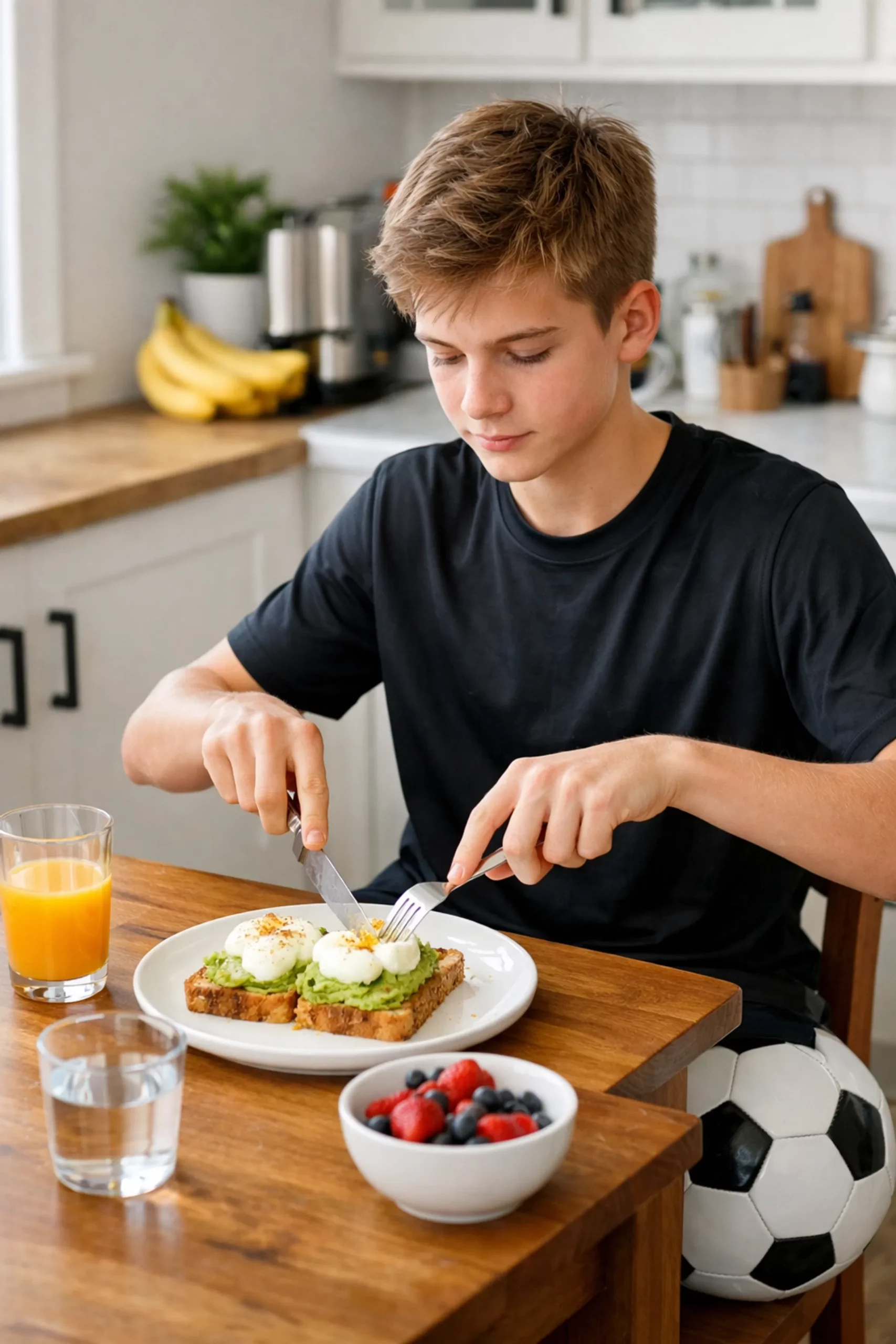
People always ask me what the hardest part of being an elite goalkeeper is. They think it’s the diving headers, the point-blank saves, or the pressure of a penalty shootout in an MLS Next match. But honestly? Those are the fun parts. The hardest part happens at 7:00 PM on a Tuesday night when my friends are ordering a massive pizza with extra fries, and I’m looking at a bowl of grilled chicken, quinoa, and greens.
It’s the discipline of the kitchen. It’s the realization that if I want to be a top-tier recruit for the Class of 2029, I can’t treat my body like a trash can. I have to treat it like a high-performance machine.
The High-Performance Car Philosophy
I like to think of myself as a Ferrari. If you owned a million-dollar high-performance car, would you pull up to a sketchy gas station and put the cheapest, lowest-grade fuel in the tank? Of course not. You’d use the best premium fuel available because you want that engine to scream when you hit the gas.
As a goalkeeper, my "engine" needs to be ready for explosive movements at a split second’s notice. If I’m carrying extra weight from "cheap fuel" (processed sugars, fried foods, sodas), I’m going to be a fraction of a second slower. In our world, a fraction of a second is the difference between a clean sheet and a ball in the back of the net.
When I’m looking for elite goalkeeper recruitment, I know coaches aren't just looking at my highlight reel. They’re looking at my conditioning. They’re looking at my body composition. They want to see an athlete who has the discipline to stay lean, powerful, and agile. Choosing the salad over the fries isn't just about weight; it’s about respect for the game and respect for my future.

The 22-Hour Rule
My coach once told me something that stuck: "The game is won in the 22 hours you aren't on the pitch."
Think about it. We train for maybe two hours a day. That leaves 22 hours where we are either eating, sleeping, or studying. If I’m crushing it for two hours at SGA training but then spending the next 22 hours eating junk and staying up late playing video games, I’m wasting my potential.
The "Elite" happens in the kitchen and the bedroom. This is where recovery happens. This is where my muscles rebuild after a heavy lifting session or a grueling diving circuit. If I want to know how to get recruited for college soccer goalkeeper positions, I have to prove I can manage my life like a pro before I ever step foot on a college campus.
My "Secret Sauce": The Vitamin Stack
I’ve done a lot of research on how nutrition affects my brain, not just my muscles. As a keeper, my brain is my most important tool. I have to see the field, communicate with my defenders, and react to a deflected shot in a heartbeat.

I’ve started focusing on a specific "stack" of vitamins that keep my machine running smoothly:
- B12 for Energy and Focus: I used to get that "afternoon fog" where I felt sluggish. B12 is essential for neural signaling. It’s like upgrading the wiring in my brain so the signals move faster from my eyes to my hands.
- Magnesium for Recovery and Sleep: Being a goalkeeper means hitting the ground. A lot. My muscles get tight and sore. Magnesium helps my muscles relax and, more importantly, helps me get into a deep sleep so I wake up ready to go again.
- Vitamin D for Bone Strength: This is huge for shot-stopping. When you’re parrying a 60mph shot or colliding with a striker, you need a solid frame. Vitamin D is the foundation for that bone health.
- Iron for Oxygen: Iron helps my blood carry oxygen to my muscles. It keeps my lungs from burning during those late-game sprints to clear a back-pass.
The Weight Factor: Power vs. Bulk
There’s a big misconception that goalkeepers need to be "big." While height is a plus, being "heavy" is a disadvantage. I focus on my power-to-weight ratio. I want to be as strong as possible while staying as light as possible.
This is where the eating habits really come into play. I aim for high-quality protein (chicken, fish, eggs) to build muscle, but I’m careful with my "easy" carbs. If I’m not training that day, I don’t need a mountain of pasta. I’d rather have a large salad with lots of colors. Each color represents a different nutrient that my body needs to stay elite.
Keeping a journal of what I eat has been a game-changer. Just like I track my training schedule, I track my fuel. It keeps me accountable. When I see it written down, it’s much harder to justify that "cheat meal" that doesn't serve my goals.
Sleep: The Ultimate Performance Enhancer
If there was a pill that could make you faster, more focused, and stronger, every athlete would take it. That "pill" is sleep.
I aim for 9 to 10 hours of sleep every night. I know, that sounds like a lot when you’re trying to manage business finance classes and a social life. But for an elite athlete, sleep is when the magic happens. It’s when the growth hormones are released.
If I only get 6 hours of sleep, my reaction time drops. My brain feels like an old computer trying to run a new game. But when I get those 10 hours? I feel invincible. I feel like I can see the ball in slow motion. That's the edge I need to compete at the highest level.

Making the Sacrifice
Is it hard to say no to the "fun" foods? Sometimes. But then I think about my goals. I think about standing on that D1 pitch, wearing the number 1 jersey, and knowing I did everything in my power to get there.
Choosing the salad over the fries isn't a "sacrifice" when you realize what you’re gaining. I’m gaining speed. I’m gaining a clearer mind. I’m gaining the confidence that comes from knowing I’m more disciplined than the guy at the other end of the pitch.
For all my fellow 2011 keepers out there: start looking at your plate as a tool. Ask yourself, "Is this helping me make a save, or is it holding me back?" The answer to that question will define your career.
Being elite isn't just a part-time job. It's a lifestyle. From the vitamins I take in the morning to the 10 hours of sleep I get at night, every choice is a brick in the foundation of my future. I’m fueling the machine today so I can dominate tomorrow.
Elite 2011 Goalkeeper looking for college scholarship. Class of 2029.
Leave a Reply