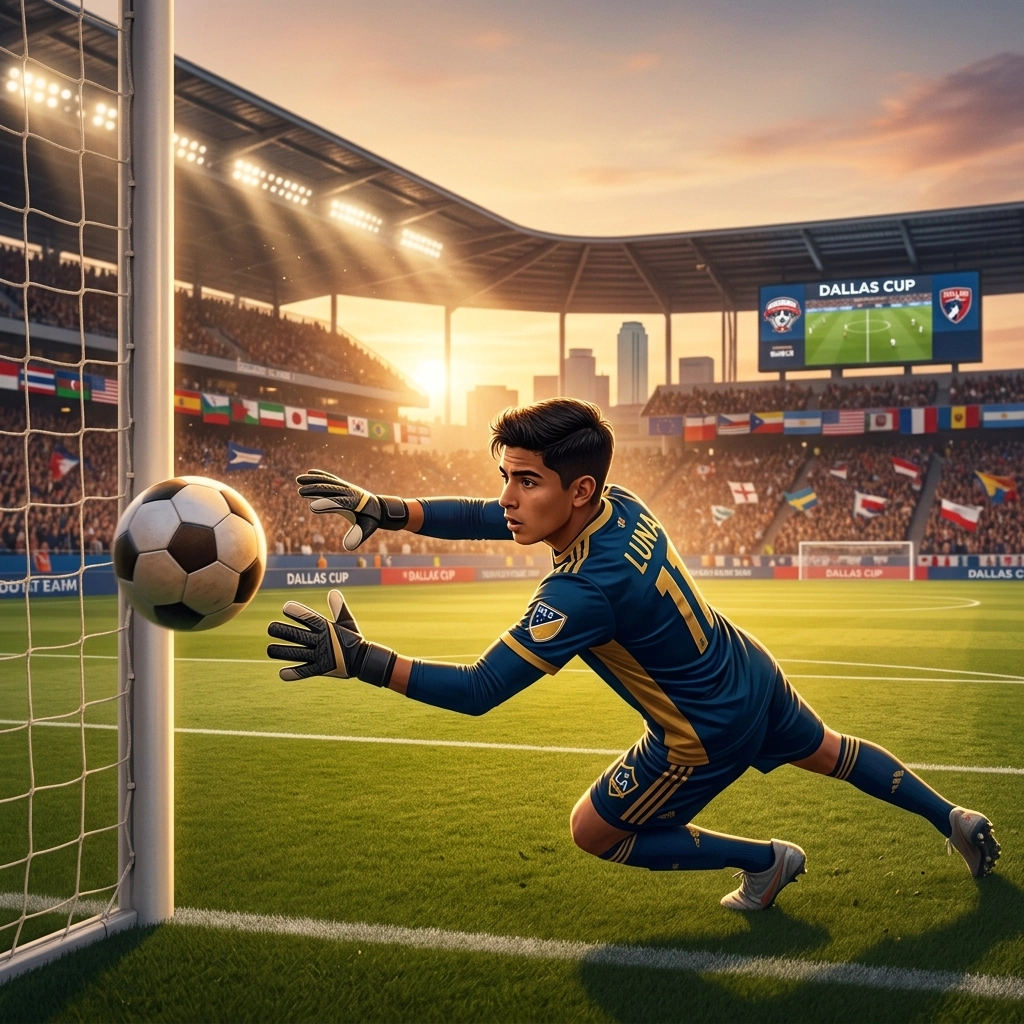
Dallas Cup. If you’re a soccer player in Texas, or really anywhere in the world, those two words carry a lot of weight. It’s one of the oldest and most prestigious youth soccer tournaments on the planet. Growing up, I’ve heard the stories of the legends who played here: stars who went on to the Premier League, La Liga, and the World Cup. For a few years now, I’ve been watching from the sidelines, waiting for my chance to step onto those pitches and prove I belong among the best of the best.
This year, that opportunity finally came, but it looked a little different than I expected. It wasn't with my regular club; instead, I was invited to be a guest player for Tableview FC, a team all the way from South Africa. Because of some visa issues, they arrived in Texas short on players and reached out for help. When the call came, I didn’t hesitate. Even though they were honest with me from day one: telling me I’d be the second keeper and likely see very little play time: I was honored. Just to be part of that environment, to train with international players, and to represent a club from across the ocean was a dream come true.
But as I’ve learned in this journey of college soccer recruiting, nothing ever goes exactly according to plan. My experience at Dallas Cup was a masterclass in nerves, heartbreak, and, most importantly, the necessity of being able to adapt on the fly.
The Sideline Perspective: Matches One and Two
The tournament atmosphere was electric. We were in the thick of the group stages, and every match felt like a final. For the first two games, I did exactly what was asked of me: I was the loudest supporter on the bench. I watched our main keeper closely, studying how he communicated with a backline that spoke with a different rhythm and accent than I was used to.

We won our first match against the third best ECNL team in Texas, 2011 Solar: a gritty performance that showed the raw talent this South African squad possessed. Their speed is second to none, and their technical skills are "mad," as they would say. The second match ended in a hard-fought loss against Houston’s best, GFI 2011 team. Going into the third game, we knew the stakes: we needed a win to have a shot at advancing to the next phase.
As a 2011 goalkeeper, you spend a lot of time preparing for your "moment." You train in the rain, you do the extra sets in the gym, and you study film, all for a split second of action. Going into that third match, I was just happy to be there. Then, Coach looked at me and said the words every backup keeper both craves and fears right before the start of the game: "Put on your gloves."
The Call to Action: Adapting Under Pressure
I can’t lie: I was incredibly nervous. This was the Dallas Cup. This was the moment I had wanted for years. Stepping onto the field with a team I had only known for a few days, playing in a formation that felt fresh, my heart was racing.
Unfortunately, the game didn't start the way we imagined. In the very first play, the opponent scored. It was a collective "team fault." We had walked onto that pitch thinking it was going to be an easy game because of how the brackets looked. We lacked the intensity required for elite goalkeeper recruitment standards, and we paid for it immediately.
As the keeper, conceding early is a mental test. You can either crumble or you can organize. I chose to organize. We had a very different lineup for this match, and we had to adjust quickly. My teammates from Tableview FC are incredibly talented, but we were still learning how to read each other's movements. This is where adapting to new formations becomes more than just a coaching phrase: it becomes a survival skill.

We regrouped. I started finding my voice, shouting directions and trying to bridge the gap between our different playing styles. We started to find our rhythm. Our identity as a fast, aggressive team began to show, and eventually, we found the back of the net. 1-1. We were back in it.
The Turning Point and the Red Card
Just as we were gaining momentum, the game took a turn that nobody could have predicted. It was a high-intensity play: two players going full speed for the ball. My teammate collided with an opposing player. It was a freak accident, the kind that makes the whole sidelines go silent.
The injury was severe enough that an ambulance had to come onto the field. My heart goes out to that player; you never want to see anyone leave the game that way. My teammate didn’t do anything more aggressive than the other player, but because of the severity of the result, the referee pulled out a red card.
Suddenly, we were down a man in the most important game of the week.
Playing a man down changes everything for a goalkeeper. The gaps in the defense get wider, and the pressure becomes constant. We fought hard, but the disadvantage was too much. The game ended 4-2. Just like that, our Dallas Cup journey was over. We didn't move past the group stages.
Licking the Wounds: The Mental Game
When the final whistle blew, I felt a heavy weight in my chest. I had that horrible feeling that it was all my fault. If I had saved that first shot… if I had positioned myself better on the third goal…
I spent the rest of the day "licking my wounds," as my dad says. It’s easy to be your own worst critic. But after the emotions settled, I realized that soccer is never about just one person. Could I have played better? Yes. Could the team have approached the start of the game with more focus? Definitely. We win as a team, and we lose as a team.

In the world of 2011 goalkeeper soccer recruiting, coaches aren't just looking for clean sheets; they are looking for resilience. They want to see how a keeper reacts when things go wrong. Do they go quiet, or do they keep fighting? I kept fighting until the 90th minute, and that’s something I can hold my head high about.
Why Guest Playing is a Cheat Code for Growth
I know many clubs and coaches don't like their players to be guest players. They worry about injury or "diluting" the player's loyalty to their home team. But after this experience at Dallas Cup, I want to do it more.
Guest playing forced me out of my comfort zone. I didn't have the luxury of a defense I’ve played with for years. I had to learn names, tendencies, and tactics in a matter of hours. That ability to adapt to new players is exactly what college coaches look for. When you get to a college program, you’re the "new guy" all over again. You have to prove yourself to a brand-new locker room. Guest playing is a shortcut to building that social and tactical flexibility.
Looking Ahead: Back to Work
I’m leaving Dallas today with a different mindset. I am incredibly honored and thankful for the opportunity Tableview FC gave me. They treated me like one of their own, and I’ll never forget the bond we formed over such a short, intense period.
But I’m also leaving hungry.
This tournament showed me exactly where I need to grow. To reach the level of elite goalkeeper recruitment, I need to sharpen my 1v1 plays. When the game gets chaotic and a striker breaks through, I need to be even more decisive. I also realized I need to get even faster at reading new formations. The faster I can "see" the game, the better I can lead my team, no matter who is standing in front of me.

The Dallas Cup was a dream, but now it’s a benchmark. I know what the "best of the best" looks like, and I know I belong there. Tomorrow, it’s back to the training ground. There’s no time to dwell on the "what ifs." There’s only time to prepare for the "what’s next."
Next year, I’m coming back. And next year, the story will end differently.
Until then, it's time to get back to work.
– Eduardo Luna


Leave a Reply